Insect populations are in massive decline across the globe. In Geneva, however, the quality of urban habitats suggests they could support significant entomological diversity. Using a target group of insects – hoverflies – we were able to:
More than 40 sites across the Geneva urban area were sampled during the summer of 2024 in three types of urban settings: residential villa neighborhoods, development areas and industrial sites. In total, we captured and identified 6'951 individuals representing 73 different species of hoverflies. The number of species per site is strongly correlated with the amount of impervious surface area on the plot, which is itself correlated with the type of urban setting.
Villa plots have both the lowest amounts of impervious surface area and the highest numbers of species, whilst the exact opposite is observed for industrial plots. Plots in development zones show intermediate values for both hoverfly species richness and the amount of impervious surface area. An analysis of the habitats present in the plot environment enabled the creation of ecological connectivity maps for the hoverfly group.
The artistic component seeks to re-establish a sensory connection with the world of insects. Dance performances, community workshops and geolocated video clips weave a dialogue between lived experience and scientific knowledge.
Artistic and scientific approaches come together on this website, which has been designed to raise awareness amongst urban planners and the general public about the challenges facing biodiversity in urban environments. These elements coexist online in the form of various interconnected maps. Through the transparent overlay of cartographic, entomological and artistic data, the aim is to find ways of relating to hoverflies and seeing the world from their perspective. The goal is to discover new ways of taking these insects into account, understanding them, and connecting with their ways of living, moving and feeding.
To share the results of our scientific and artistic research, participatory workshops have been designed. Available throughout the Geneva region, they are offered to institutions upon request.
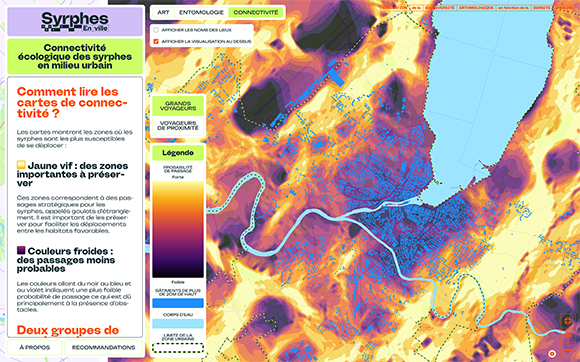
A connectivity map for «long-distance traveller» hoverflies.
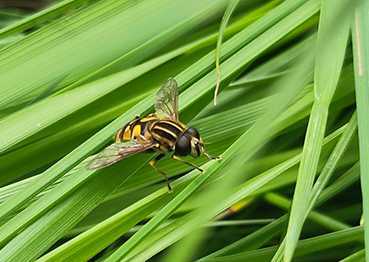
Thumbnail image: Syrphe Hellophylus pendulus @Alain Dubois
The Hoverflies in the city project is one of the four selected projects in the «Territoire en recherche» call, funded by CITÉ, Centre interdisciplinaire pour la transition des villes et territoires de la HES-SO Genève.
Project partner(s)
Project leader - team
Dominique Fleury
(HEPIA),
Alain Dubois
(HEPIA),
Claude Fischer
(HEPIA),
Alizée Testard
(HEPIA),
Mia Critico
(HEPIA),
Charlène Heiniger
(HEPIA),
Romain Martinuzzi
(HEPIA),
Loreto Urbina
(HEPIA),
Lise Deront
(HEPIA),
Patrice Prunier
(HEPIA)