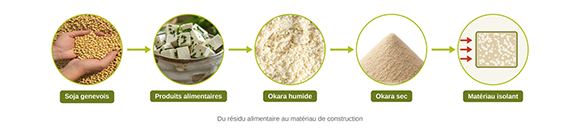
The production of tofu and soya drinks leaves behind a moist pulp known as "okara". In Geneva, the company Swissoja produces around 75 tonnes of it each year. The material is wholesome and rich in fibre. Yet it is disposed of, at the producer's expense.
LEMS and Swissoja are exploring another path. What if this okara became a building material? The idea rests on a simple property. Once dried and ground, okara forms a light, porous aggregate. (An aggregate is a granular material mixed with a binder, much as sand is in a mortar.) The pores of okara trap still air, and still air is the best insulator there is.
Understanding the material before formulating it
A feasibility study began in 2026, supported by the Office for the Promotion of Industries and Technologies. It started with an essential step: characterising the material. To characterise is to measure what a material is made of and how it behaves. Six analytical techniques were applied to the same batch of dried powder. They reveal which chemical elements are present, which molecules make up the fibres, how the material is organised internally, how it withstands heat, and how large its particles are.
The results describe a consistent material. The powder is homogeneous from one sample to the next. Its particles measure about a third of a millimetre, a fineness compatible with spray application. Its mineral content is low and dominated by potassium and calcium. Thermal degradation begins at around 200 degrees, which sets the limits of its range of use.
Two routes to valorisation
The first route is an insulating mortar. Okara replaces part of the conventional aggregate, making the mix lighter and slowing the passage of heat. The second route concerns fire performance. Combined with a suitable additive, okara can form a carbonised crust that shields the material beneath it. This crust slows the spread of flame.
A target figure
Success hinges on a single quantity: thermal conductivity. It measures how quickly heat travels through a material. The lower the value, the better the material insulates. The project targets a range of 0.05 to 0.10 watt per metre-kelvin. For comparison, an ordinary cement mortar sits at around 1.2, some fifteen times higher. Hemp concrete, a bio-based material already on the market, comes in at about 0.07. (Bio-based means derived from plant or animal matter rather than from fossil or mineral resources.)
What comes next
Formulations will be developed and tested through to spring 2027. A decision will then be taken on moving to a prototype. If the bet pays off, a Geneva residue will become a Geneva material.
Project partner(s)
Project leader - team
Abdelkrim Bennani
(HEPIA),
Elio Savoldelli
(HEPIA)
