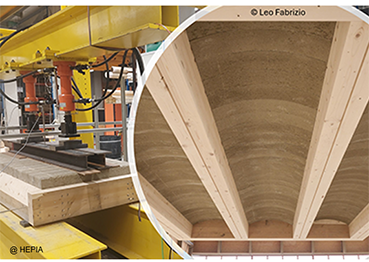
The Terradek - The Structural Infill Block System research project is the result of a collaboration between the LEMS laboratory (HEPIA), TERRABLOC SA, B+S INGENIEURS SA and BATJ SA. Its objective is to develop a structural floor system based on compressed earth infill blocks combined with a timber joist framework, creating a floor that combines structural performance, environmental sustainability, and aesthetic quality.
In response to the challenges of urban densification and the environmental impact of the construction sector, this system provides a concrete alternative to conventional concrete slabs.
The project's key innovation lies in the use of prefabricated compressed earth structural infill blocks that, unlike existing systems, actively contribute to the load-bearing structure. Inspired by Florence's Ponte Vecchio (1345), these elements rely on the principle of arches working purely in compression, thereby overcoming the inherent weakness of raw earth in tension. Vertical loads are efficiently transferred through an intelligently designed vaulted form, minimizing the use of structural timber.
Comparative environmental assessments demonstrate a remarkable reduction of 51% in embodied energy and 63% in CO₂ emissions per square metre compared with traditional concrete slabs. Even when compared with composite timber-concrete floor systems, the Terradek solution reduces embodied energy consumption by 20% and CO₂ emissions by 22%.
The construction process involves the off-site assembly of 2.6 × 4.5 m modules weighing approximately 4 tonnes, which can be easily transported and installed by crane. This prefabrication approach significantly accelerates on-site construction while protecting the system from weather exposure before the building is made watertight.
This high-quality natural material fully meets the demanding requirements of sustainable construction (including Minergie-ECO certification) and aligns closely with Switzerland's Energy Strategy 2050, contributing to a more responsible and environmentally respectful built environment.
Project partner(s)
Project leader - team
Abdelkrim Bennani
(HEPIA),
Florian Fazio
(HEPIA)